AR Project description
This document contains an overview of the project, describing its motivation and describing its functional details.
The motivation
Taking inspiration from a Harvard’s Ed School article, ‘Bored Out of Their Minds’ (Harvard Graduate School of Education, 2017), our development team believes that engaging educational tools can have a transformative effect. Based on Mehta’s assertion that ‘engagement is a prerequisite for learning,’ we aim to create a VR history application that combats the epidemic of classroom boredom and helps students regain their enthusiasm for learning.
According to a Harvard Graduate School of Education article, ‘Bored Out of Their Minds’ (Harvard Graduate School of Education, 2017), engaging educational tools can make a significant impact on the learning process. By drawing on Mehta’s assertion that engagement is a prerequisite for learning, we aim to create an application that utilizes Augmented Reality technology in order to combat classroom boredom and renew students’ enthusiasm for learning.
Subject
The chosen subject for this project is Ancient Roman History.
The idea
Take a moment to imagine yourself sitting in a classroom, attentively watching a teacher present slides about ancient Roman history: (see image below)

In front of you lies an assortment of cards that were given to you by your teacher: (see image below)

As the lecture unfolds, the teacher instructs students to identify a specific card from the set and capture it with an AR smartphone application. While sorting through your cards, you come across one marked “card 1”, which you immediately scan. This action produces an augmented version of a Roman Market building. Holding your phone, you delve into this digital realm, engaging with centurions and citizens, absorbing their narratives, and pausing occasionally to read insightful pop-ups that appear on your screen.
Interactions
There will be quite few interactions available within the augmented object:
- Scale and rotate it
- Peer inside the buildings.
- Tap on objects for additional content:
- Audio narration (e.g., a soldier telling a story)
- Emerging text message
The heart of Roman commerce
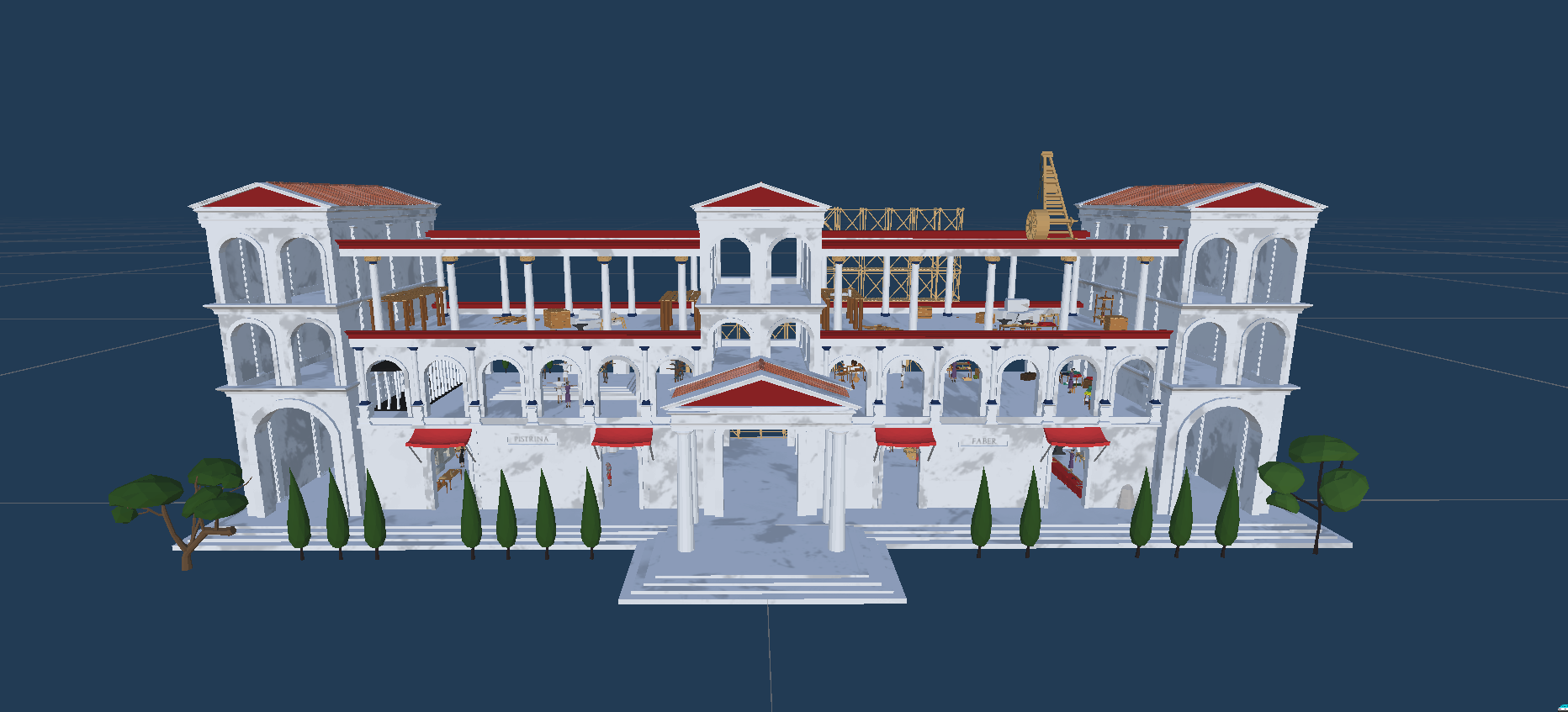
Allow us to introduce a prototype of a market object that our team managed to develop.
The initial structure of the market hall was empty; Therefore, we have dedicated significant effort to its design, adding a variety of elements and characters.
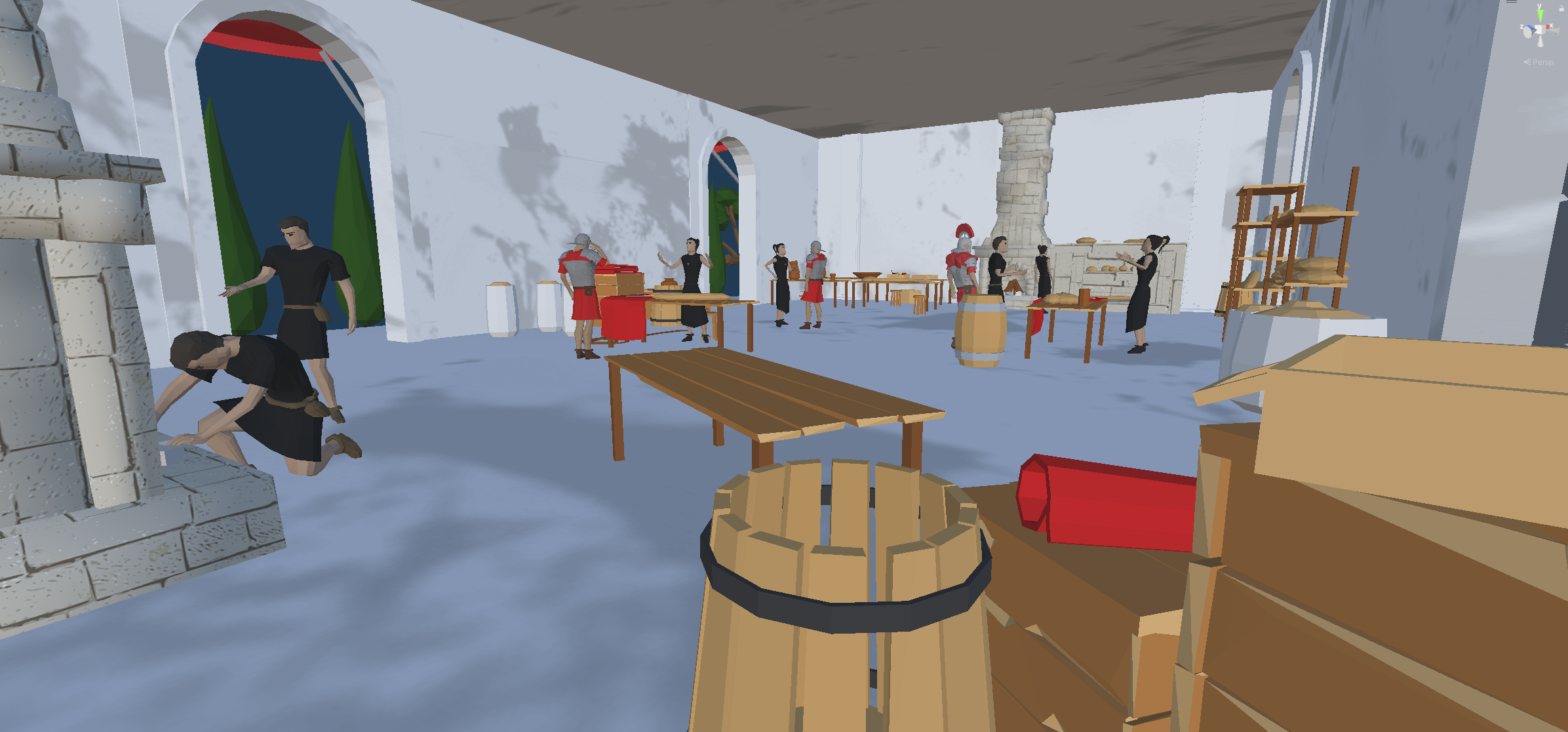
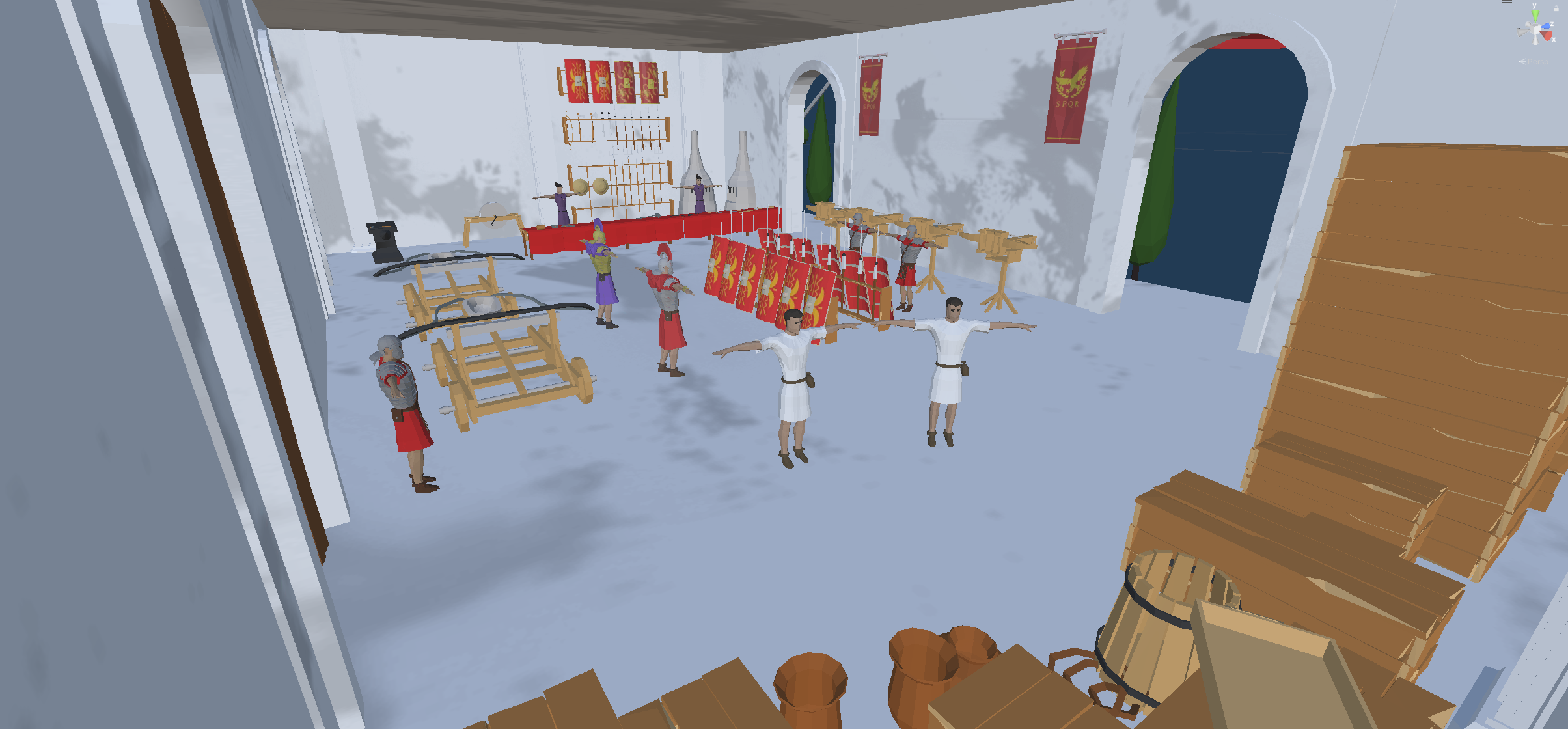
You can see Prototype images below:
Market building prototype
Bakery prototype
Armory building prototype
Technology:
As it is clearly evident, we are leveraging AR image tracking. Users can place a designated card on a table and, upon scanning it with their device, witness a 3D structure emerging.
There will be multiple image Targets (variety of cards) that the app will be able to recognize and render a particular prefab based on the trigger – the image itself.
References:
Harvard Graduate School of Education. (2017). Bored Out of Their Minds. https://www.gse.harvard.edu/ideas/ed-magazine/17/01/bored-out-their-minds